Tolkien's Dead Marshes: Not Dead, Not a Marsh
The first thing you should know about me is that I love The Lord of the Rings. The second thing is that I’m a professional ecologist. These two things go together.
Even if you are only familiar with The Lord of the Rings (LOTR) in passing, you’re likely aware of Tolkien’s deep, abiding love for the natural world. You’ve heard jokes about how much time this man spends describing trees. You know the Ents march to war. You remember the scene from The Fellowship of the Ring movie where Arwen summons horses made of water.
This love is something Tolkien and I have in common. Since I was a kid, I have loved nature—and fantasy stories. My relationship with LOTR is long and slightly convoluted. I read The Hobbit in elementary school and (to my eternal shame) didn’t like it. In middle school, I fell madly in love with the films and watched them repeatedly with my two best friends. I directed my high school’s production of The Hobbit. It’s important to me that you know that our Smaug was made out of a fiberglass dinosaur head that had been retired from a museum.
I tried several times to read the trilogy and just could not get through it. Tolkien’s writing—bless his heart—can be a bit dry. Fellowship has kind of a slow start. Although I personally adore Tom Bombadil, it’s good that the films skip from the Shire to Bree. LOTR is the foundation of modern fantasy for good reason, but it’s not easy to get into. It took me several tries. Finally, the summer before I started college, I gave it another try—and got sucked in.
I don’t know what changed. Maybe I finally had time and energy to spare after a harrowing four years of high school. Maybe my taste in books changed. Maybe I was old enough to be patient with a slow book. But I finally devoured The Lord of the Rings.
Tolkien’s love for language is crammed into every page. He invented languages and wrote poetry and mythology to inhabit them. He mined the rich cultural history of England, Finland, and Germany to populate Middle-earth. But there is one word, one concept, that Tolkien is inconsistent on. This inconsistency shocks me, frankly. It goes against his care for language and his love for nature.
The Dead Marshes. They are not dead, and they may not be marshes at all.
Marshes are just one of several types of wetlands. The types of wetlands, which I’m about to describe, are defined primarily with the types of plants that grow there. All types of wetlands are saturated with water at some point—permanently, seasonally, or daily. The salinity and acidity of the water matters, too. Wetlands are some of the richest and most productive ecosystems in the world. Many species rely on wetlands for breeding, raising young, or foraging. The plants in wetlands filter and clean the water that passes through them, and their roots hold soil in place and reduce erosion. All wetlands are capable of storing massive amounts of carbon. Coastal wetlands are famous for this; you may have heard the term “blue carbon,” which specifically refers to the carbon that is stored by coastal ecosystems like salt marshes, mangroves, and seagrass meadows.
Here I present the types of wetlands alongside Tolkien’s in-text descriptions of the “Dead Marshes” from The Two Towers. There’s textual evidence for a few different wetland types, so we’ll start with those.
A marsh is dominated by grass or grass-like species; basically, nothing hard and woody. This can include water lilies, cattails, and reeds. Some marshes are inland; think about the cattails growing on the edge of a retention pond in a parking lot. Other marshes are defined by their exposure to the tides. Nontidal marshes along rivers are beyond the reach of the tide. You might be surprised to learn how far inland the tide can extend, though this depends on the river, the strength of the tide, and other factors. The tides change the salinity and sometimes temperature of the water, so anything that lives in tidal waters needs to be adapted to a range of conditions.
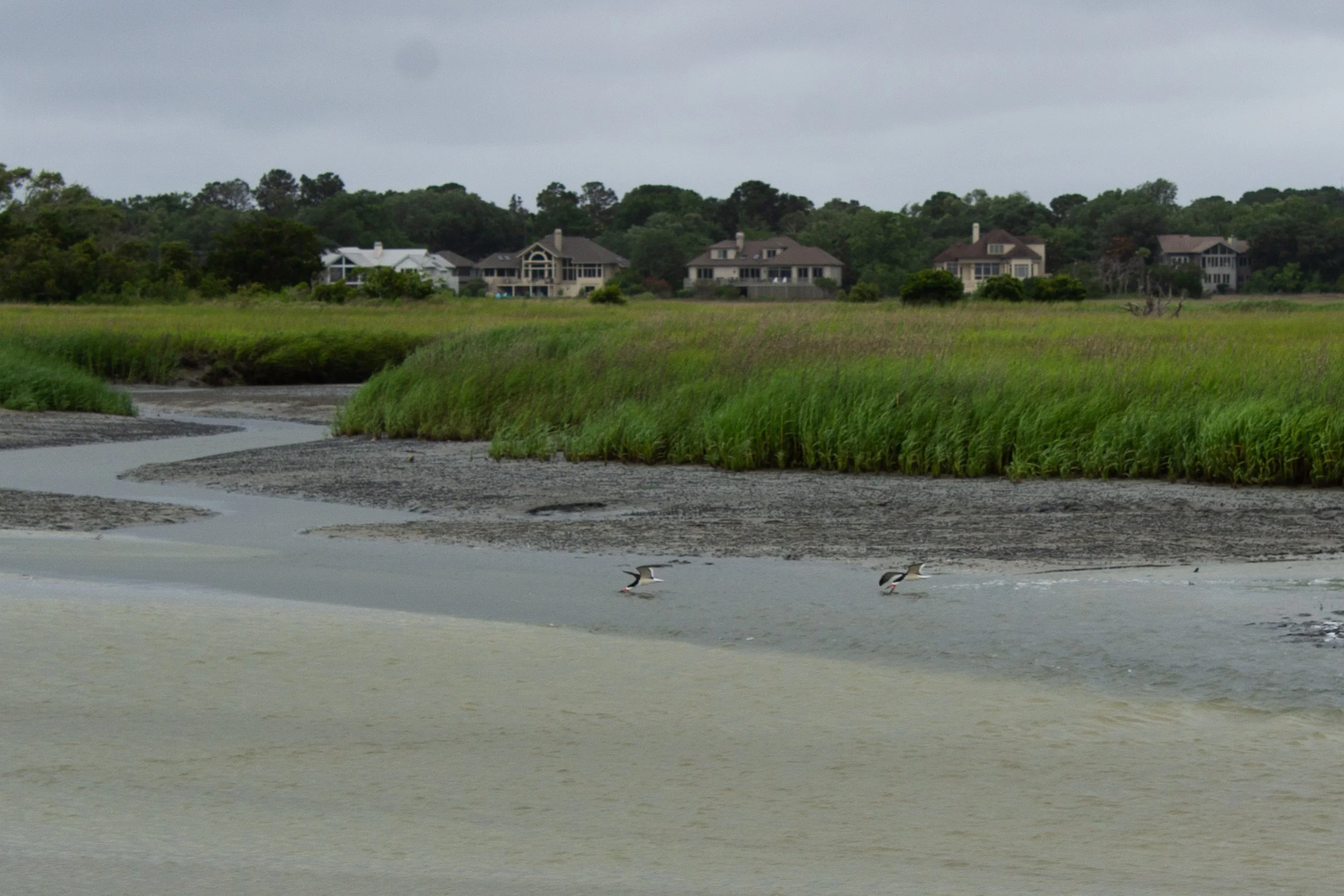
This is a tidal salt marsh. Notice the grasses, and the exposed ground indicating the low tide. The two birds are black skimmers, so-called because of their “skimming” foraging behavior. The lower side of their bill is longer than the upper to make this possible. Photo taken by me on Hilton Head Island, South Carolina, USA.
So, are the Dead Marshes a marsh? Maybe! It’s the name, after all. Tolkien also refers to “a great brown reed-thicket” and “broken grass blades.” Reeds and grasses are certainly marsh plants.
But he’s inconsistent; otherwise, I wouldn’t go to the trouble of writing about this. I wouldn’t subject my friends to this rant during our annual LOTR viewing party. Tolkien’s carelessness with wetland terms haunts me. What was he doing? He’s normally so careful with his words! This is the man who—I’m getting off-track.
Tolkien mentions two other types of wetlands in this chapter: bogs and fens.
Bogs are acidic. They are dominated by moss species, especially Sphagnum mosses, and receive their water from rainfall. Other types of wetlands might be fed by underground sources, or sit at the edge of a river or ocean that brings in fresh water. Over time, partially decayed mosses build up in the bottom of the bog to form peat. Historically, peat has been used as a source of fuel or fertilizer. Because bogs are fed by precipitation only, they are less nutrient-rich than other types of wetlands. North American bogs are famous for their carnivorous plants, including sundews and pitcher plants. These plants are carnivorous because of the lack of available soil nutrients. Neat!
You may have heard of partially preserved “bog bodies,” which are found in European bogs and can be hundreds or thousands of years old. The unique conditions of a bog preserve human bodies: high acidity and low oxygen levels slow decomposition. Gross, but cool.
Are the Dead Marshes actually a bog? Maybe! The word “bog” pops up once or twice in the text. If Sam and Frodo literally see dead faces in the water—and that’s debatable—then the Dead Marshes could be a living bog, full of bog bodies from an ancient battle against Sauron.
Fens are similar to bogs because they also form peat. However, fens are far less acidic than bogs because they get their water from sources other than precipitation. This makes them more nutrient-rich and able to support more types of plants. The peat-forming Sphagnum mosses are less prevalent in fens than in bogs, but they’re still there. Over time, peat formation can block the groundwater supply from reaching the fen. At this point, a fen could become a bog.
Could the Dead Marshes be a fen? Maybe! The word “fen” appears in Tolkien’s descriptions of the landscape, such as “the fens grew more wet” and “on either side and in front wide fens and mires now lay.” The word “mire” is a general term for wet ground. This is a minor and very niche gripe to have with a beloved text, but I’m shocked that the man who helped write the Oxford English Dictionary is using these words as if they’re interchangeable.
There’s one more type of wetland I’d like to introduce. It’s not mentioned in the The Two Towers, but that’s okay with me; this post is already longer than I wanted it to be. Swamps are a type of wetland dominated by trees. Think of coastal mangrove forests, which are magical places that you should visit if you can. I’ve been snorkeling in mangroves, and there are thousands (probably millions) of tiny lives teeming among their roots. I’ve seen miniscule fish, baby crabs, waving seagrasses, and a diving cormorant. But I digress.
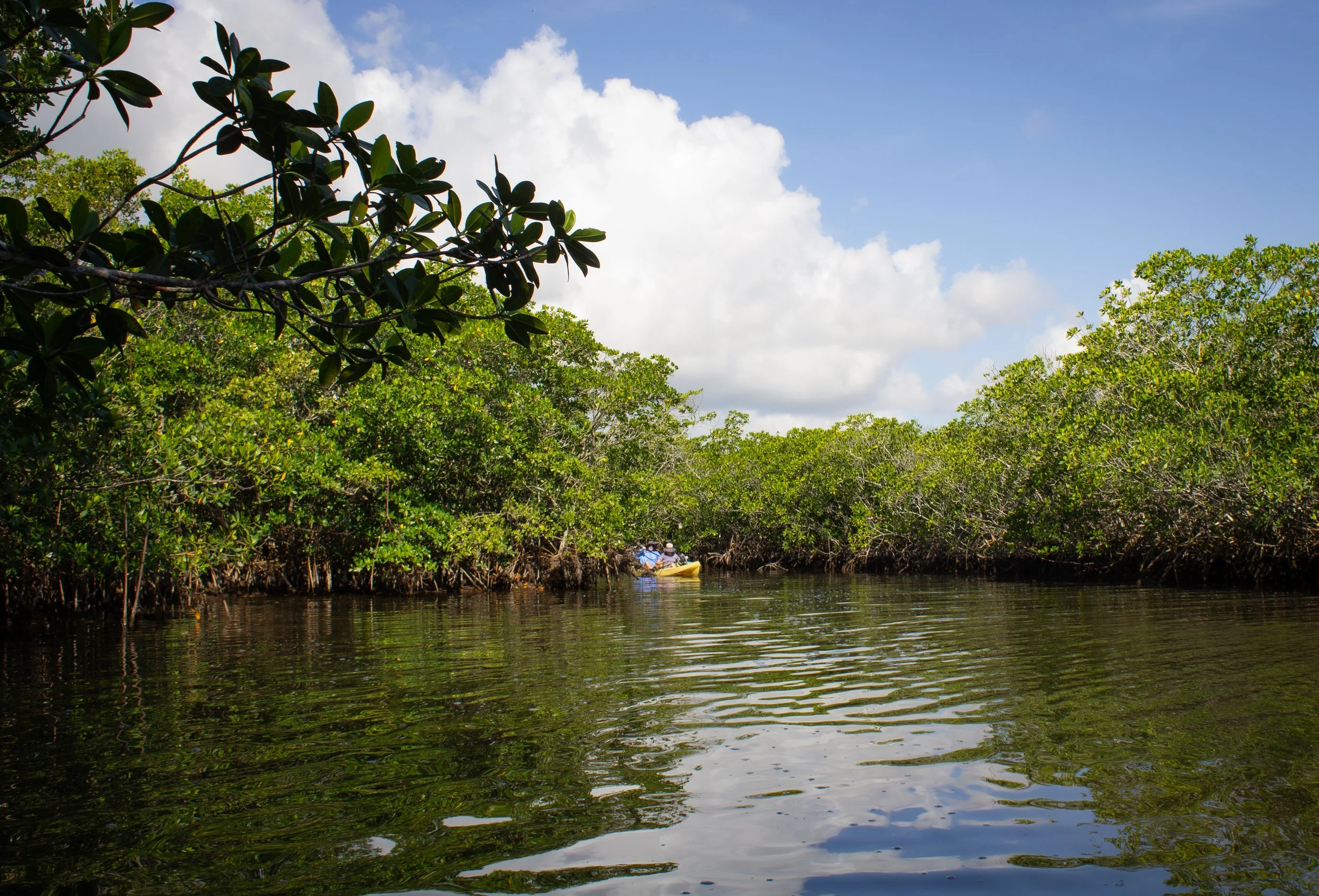
This is a mangrove swamp, which is dominated by mangrove trees. The tide moves freely among the roots of the trees. Many species call mangrove swamps home. Photo taken by me in Biscayne Bay National Park in Florida, USA.
What are the Dead Marshes? I don’t know. There’s textual evidence that they could be a marsh, as the name suggests. They could also be a bog, or a fen, or some kind of bizarre combination. I could see a pockmarked landscape covered with mosses, grasses, reeds, and stunted trees. Some pools of water could be choked by peat and acidic enough to preserve bodies. Only Gollum knows the way through the quagmire. And only Tolkien knows exactly what he was describing.
That weirdo (affectionate).