Tolkien’s Fangorn: This Forest is Old
If you ever get the chance, visit the redwoods on the west coast of the United States. I’ve been lucky enough to stand at the feet of those massive trees. There’s a hush in a grove of redwoods, a sense of something otherworldly. The trees are hundreds of years old. They grow slowly, withstanding fire and flood and storm to reach for the sky. You feel your own smallness.
I imagine this is the feeling that Tolkien was trying to evoke in Fangorn Forest.
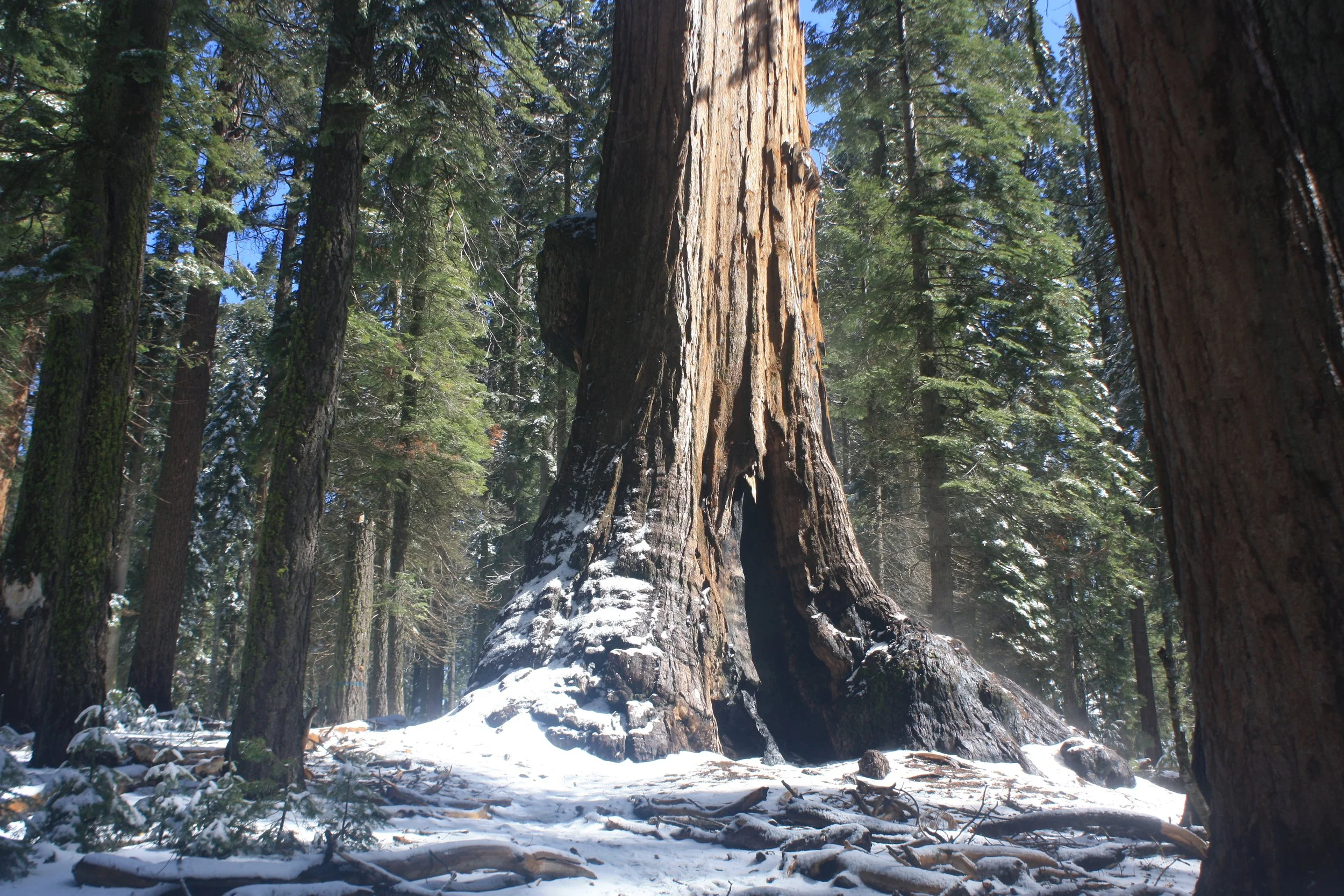
The aptly-named Giant Forest sequoia grove in Sequoia National Park, California. Photo by me.
If you’ve seen The Lord of the Rings, Fangorn Forest is a memorable sequence. Merry and Pippin, fleeing Orcs, run into the ancient shadow of Fangorn Forest. The forest is shrouded in mystery and mythology; the people of Rohan steer clear of it. But Merry and Pippin have no choice, and next to no knowledge of where they are or where they’re going. They only run—and find themselves in the presence of Fangorn himself. Treebeard, the great Ent.
Tolkien fans believe that this character is based on C.S. Lewis, a dear friend of Tolkien’s and a fellow fantasy writer. But we will speak no more of Lewis here, because I will go off on a hopeless tangent. The Chronicles of Narnia was my gateway (drug) into fantasy.
Fangorn Forest is old. But how can you tell? Old, mature forests like Fangorn have specific characteristics that younger forests do not. To fully understand forest ages, we’ll need to talk about different types of ecological succession. Succession refers to what species are present in an ecosystem, and how this changes over time.
Primary succession is when the beginning environment is devoid of life. Think bare rock or lava flows. The eruption of Mount St. Helens is an example I learned in school: the volcano blasted away its own mountainside, leaving nothing behind. And yet, life persisted (it does that). The first living things in this bare space are small: microorganisms, lichens, and mosses. These species need very little to survive, and their presence paves the way for bigger species later. They wedge themselves into minute crevices in the rock, hang on, and begin to change their environment.
This takes us to secondary succession, which comes after an existing community is disrupted. The recovery of Yellowstone National Park following fires is a good example. Yellowstone is a fire-dependent landscape; wildfires occur naturally and frequently here. (The fires are getting bigger, but that’s a different conversation.) When the trees and undergrowth are burned away, the bare soil beneath isn’t barren: it’s full of organic material, and buried seeds can sprout. Because the conditions are much more hospitable than with primary succession, secondary succession can happen relatively quickly. Fast-growing species of grasses, shrubs, and trees like pines spring up to fill the space. That’s succession.
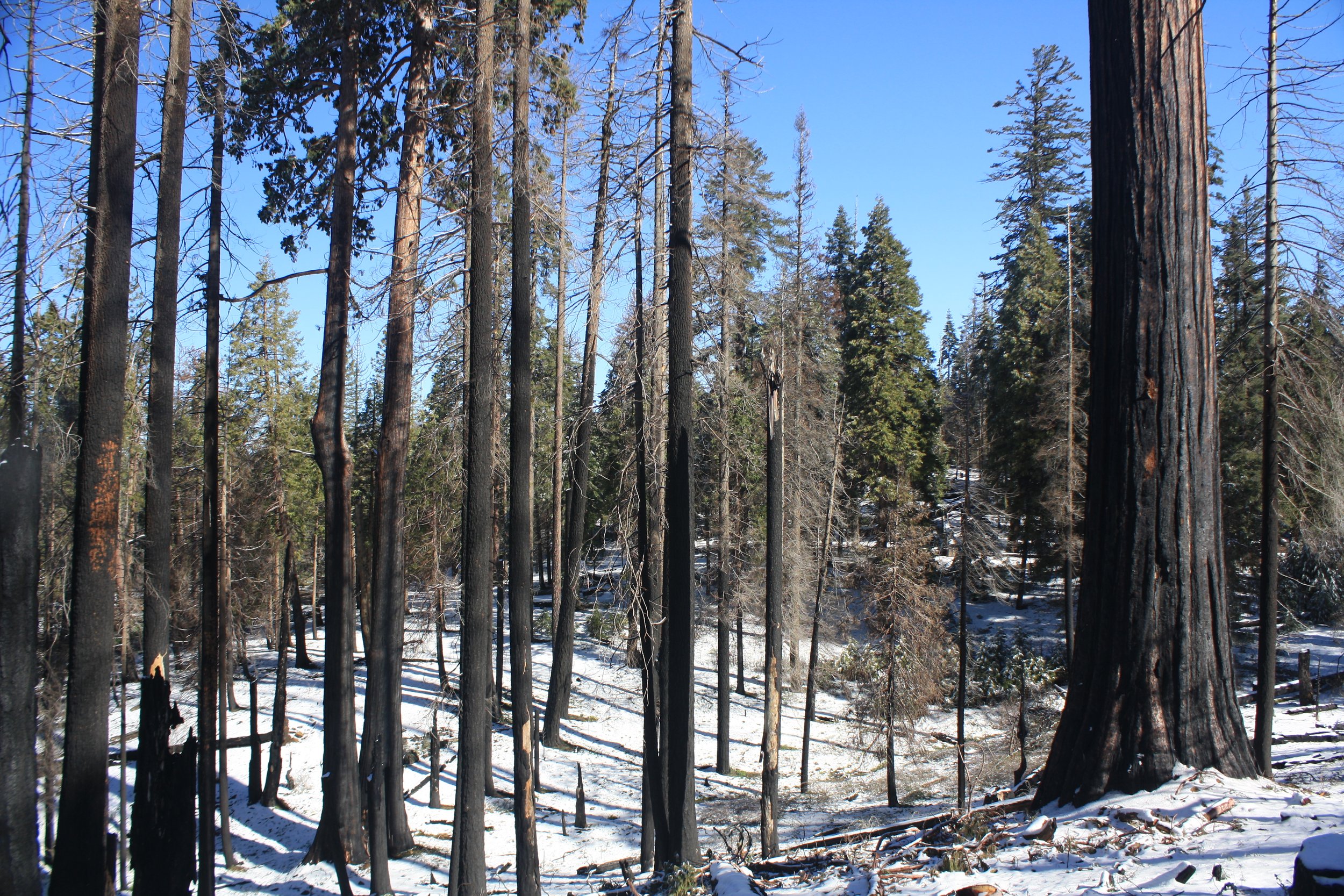
Sequoias After Fire
Fire-dependent ecosystems are prepared for fire and recover easily. Sequoias have thick bark that protects them from fire damage. Their cones actually depend on the extreme heat of a fire to dry them out and release their seeds; these are called serotinous cones, and many species of conifers have them. After the fire, the undergrowth in the forest is cleared out. Young redwoods have little competition for space or light, so they can grow to the majestic sizes that we’re used to. You can see the fire damage on the bark of these sequoias.
Taken in Sequoia National Park by me.
Time passes, and the trees get bigger. Species that grow slower, like oak or hickory, overtake the initial wave of growth. The understory becomes denser. Many different species of animals can inhabit different parts of the forest, from the roots of the trees to their crowns. The big, tall trees take most of the sunlight at the top of the canopy; the floor of the forest is dim and covered with shade-tolerant plants. Occasionally, a fallen tree provides a clearing, but the forest fills that in. This stable state of existence is called the climax community, and it will remain in this equilibrium until the next major disturbance.
This is how Pippin describes the feeling of Fangorn Forest: “...very dim and stuffy, in here…Look at all those weeping, trailing beards and whiskers of lichen! And most of the trees seem to be half covered with ragged dry leaves that have never fallen. Untidy.”
And from Treebeard himself:
In my own land, in the country of Fangorn,
Where the roots are long,
And the years like thicker than the leaves
In Tauremornalómë
Fangorn is an ancient forest that exists outside of time and memory. This is the feeling that you get from an ancient grove of trees, from a mature forest rich with life. This is the feeling of the redwoods.