Tolkien’s Wargs: a Keystone Species
Ecologists are, by our nature, an odd group of people. We like to play in the mud well into adulthood. We specialize in niche topics and see details others miss—the leaf orientation of a maple tree compared to an oak, or how a hawk flies differently from a crow. We see beauty where many people would not. The response to a picture of a millipede or snake is “Aw, cute!”
I have always found Tolkien’s wargs to be adorable. The wargs that we see onscreen in the Peter Jackson films look like squashed hyenas. They’re drooling, snarling, and likely in need of a bath. In true ecologist fashion, my first response was “Aw, cute!”
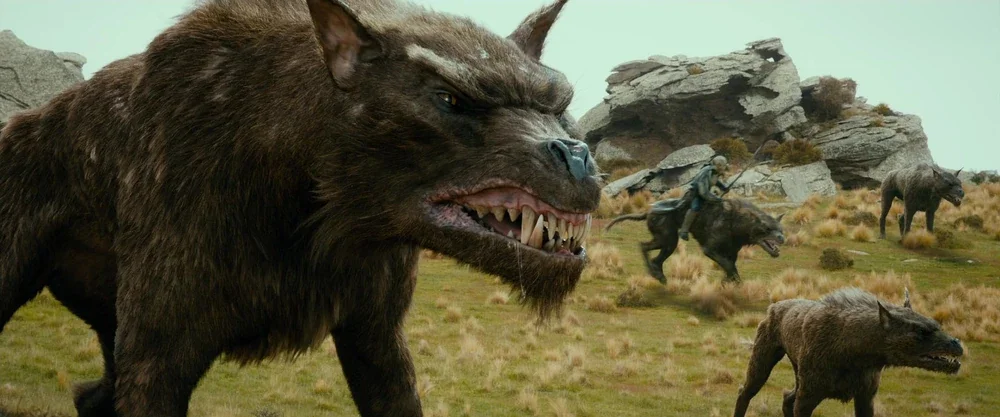
See? Adorable. Image from The Two Towers, New Line Cinema.
J.R.R. Tolkien, like an ecologist, had many niche interests. He made his living as a philologist: someone who studies language. He famously authored part of the Oxford English Dictionary. Tolkien’s fascination with words, their origins, and the cultures that spoke them led him to create the Elvish languages. This in turn spawned the world of Middle-earth, The Hobbit, the Lord of the Rings, and the Silmarillion. Tolkien’s commitment to the structure and history of language in his books is astonishing.
Much of Tolkien’s love for language and culture centers around Norse mythology. The Norsemen lived primarily in Sweden, Norway, and Denmark. Their religion famously includes the one-eyed god Odin, the thunder god Thor, and the trickster Loki. In the Norse view of the universe, there are Nine Worlds occupied by beings like gods, elves, dwarfs, and humans. The realm that humans occupy is Midgard, which can be translated as “middle earth.” I could talk at length about Tolkien’s interest in Norse mythology. He famously translated Beowulf, and his scholarship around that epic has had a lasting impact.
Wargs exist in Norse mythology. They are, as you might guess, giant wolves. The wolf Fenrir destroys Odin in the apocalyptic battle of Ragnarök. Fenrir’s children, Sköll and Hati, chase the Sun and the Moon. Several characters in Norse mythology use wolves as mounts—just like Tolkien’s Orcs.
Wolves are revered across cultures. The story of the founders of Rome, Romulus and Remus, has the infant boys suckling at the teat of a she-wolf. The Oneida people, whose ancestral lands are located in the state of New York, identify with three clans: the turtle, the bear, and the wolf.
In ecology, we talk about the concept of a “keystone species.” This term refers to a species whose presence has a big impact on the structure of an ecosystem, like the keystone of an arch. If you remove the keystone, the arch falls down. If a keystone species is absent from its ecosystem, the ecosystem structure collapses.
Wolves are perhaps the most well-known example of keystone species. To truly understand their impact on their ecosystems, we should look at the Yellowstone wolves.
Yellowstone National Park sits at the border between the U.S. states of Wyoming and Montana. It’s a beautiful landscape, perhaps most famous for its impressive geysers and being a supervolcano. It’s also the home to some of North America’s most famous large mammals, including bison, moose—and wolves. When the park was first created in 1872, there were no restrictions on hunting. Wolves, who were and are viewed as undesirable predators, were widely hunted and ultimately killed off within the park.
So what happened next? The entire ecosystem changed. The elk population, normally kept in check by packs of hunting wolves, exploded. This impacted plants like cottonwood and aspen, which are elk’s favorite food. The loss of cottonwood and aspen, which grow along streambanks, made the land more susceptible to erosion. The coyote population also increased, and the coyotes hunted pronghorn antelope and foxes.
In short, the arch collapsed. The entire nature of Yellowstone Valley changed.
After half a century of elk hunting, political back-and-forth, and a greater understanding of ecology, the first wolves were reintroduced to Yellowstone in 1995.
I’ve been lucky enough to visit Yellowstone three times in my life. The first time was in 2007, over twenty years after the wolves were reintroduced. And, reader—I saw them.
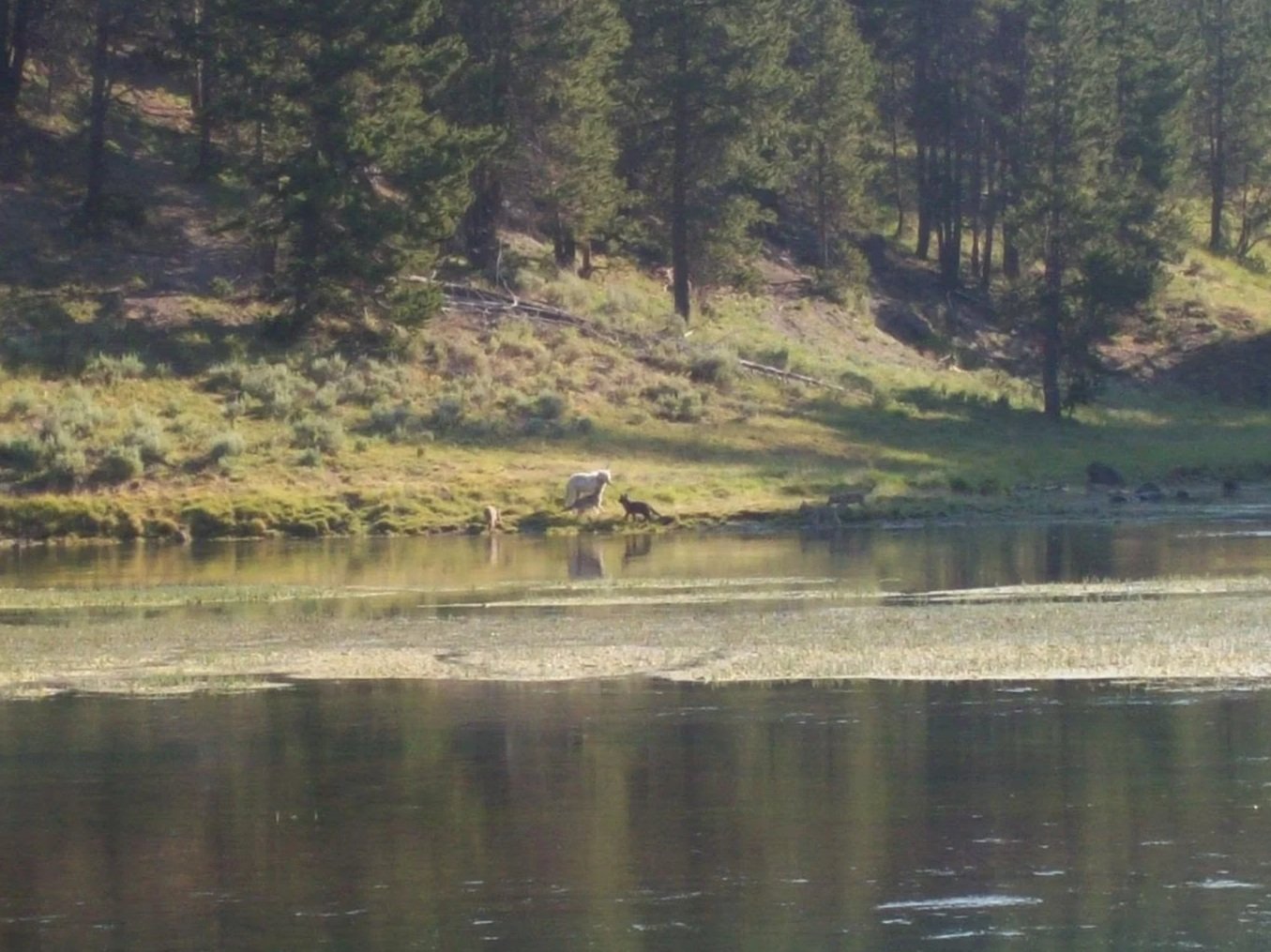
Photo taken by me in Yellowstone National Park.
The Yellowstone wolf reintroduction was already famous. I’d read an article about it in some children’s science magazine. Like many kids, I loved wolves and romanticized them. I was already a Jack London fan. The animated film Balto was a staple in our house. More than anything, I wanted to see the wolves. I knew it was unlikely; it’s not safe for large predators to be around humans for either party. The wolf packs of Yellowstone have territories that cover the less traveled, backcountry parts of the park.
But on the side of the road, there was a crowd. You always pull off when there’s a crowd on the side of the road in a U.S. National Park. And there, across the river: a mother wolf with puppies.
I’ll never forget it. You could make out their tiny shapes, running up and down the hill and playing. They were just like my dog at home. The mother was white: a beautiful, almost mythical color. She drifted across the landscape like a ghost.
On a sunset rafting trip down the Yellowstone River, the tour guide told us how things are different now that the wolves are back. You’re more likely to see moose; without the elk overgrazing, young willows are more likely to flourish on the riverbank, and willow is a moose’s favorite food. The wolves’ presence in the park changes how coyotes hunt and behave, which affects other species like pronghorn and foxes. Foxes hunt even smaller species, and so the effect of the wolf cascades down the food chain.
This magnificent, vital creature is the inspiration for Tolkien’s wargs. I like to imagine they have a similar importance to the ecology of Middle-earth, but I don’t think our beloved Professor was thinking about it in that way. Nobody’s perfect.